Author: Sarah VanVickle Chaves, Director of IVD and Scientific Writing Services, Ph.D. Molecular and Cellular Biology
If your company is planning to market a medical device in the European Union, you have probably heard the terms MDR and CER. You may also have heard that the requirements are more demanding than they used to be. Both are true. But the goal is straightforward: manufacturers need to show, with well-organized clinical evidence, that their device is safe, performs as intended, and continues to do so after it reaches the market.
Why MDR changed the conversation
The European Medical Device Regulation (EU MDR 2017/745) raised expectations for clinical evidence, post-market surveillance, and benefit-risk evaluation. Compared with the former Medical Device Directive framework, manufacturers now need more than a historical safety record or a one-time literature review.
Notified Bodies want to see that clinical claims are supported by current evidence, that risks are understood and controlled, and that the manufacturer has a plan for monitoring the device once it is in real-world use.
- Clear support for intended purpose, indications, and clinical claims
- A current state-of-the-art review that reflects available therapies and standards of care
- Systematic literature search methods that are objective and reproducible
- Integration of post-market surveillance (PMS) and post-market clinical follow-up (PMCF) data
- Benefit-risk conclusions that align with risk management, labeling, IFUs, and technical documentation
What is a Clinical Evaluation Report?
A Clinical Evaluation Report, or CER, is the written outcome of the clinical evaluation process. It explains what clinical evidence exists for the device, how that evidence was selected and appraised, and whether the evidence supports the device’s safety, performance, and benefit-risk profile.
In practical terms, the CER is where the manufacturer connects the dots between clinical data, device claims, patient risk, regulatory expectations, and the broader clinical landscape.
The clinical evaluation process, in three steps
A strong CER usually starts long before the report is drafted. The most effective programs treat clinical evaluation as a planned, repeatable lifecycle activity.
Start with a Clinical Evaluation Plan
The Clinical Evaluation Plan (CEP) defines the scope of the evaluation and explains how evidence will be identified, collected, appraised, and analyzed. A thoughtful CEP helps avoid gaps later, especially when the CER is reviewed against PMS, PMCF, risk management, and technical documentation.
- Intended purpose, indications, contraindications, and clinical claims
- Target patient populations and intended users
- Applicable General Safety and Performance Requirements (GSPRs)
- Clinical data sources, including investigations, literature, PMS, and PMCF
- Benefit-risk acceptance criteria and appraisal methods
- Planned update intervals and triggers for review
Collect and evaluate the evidence
Clinical evaluation is cross-functional by nature. Regulatory, clinical, quality, risk management, engineering, PMS, and medical writing teams often need to work together to understand the device, evaluate the available data, and identify any evidence gaps.
The evidence base may include clinical investigations, published literature, PMS data, PMCF findings, registry data, complaint trends, vigilance information, usability findings, and risk management outputs.
Build the CER narrative
The CER brings the evidence together in a structured, scientifically defensible way. MEDDEV 2.7/1 Rev. 4 continues to be widely used for CER structure and methodology, even as MDR and MDCG guidance shape current expectations.
State of the art: the context Notified Bodies expect
The state-of-the-art section is often one of the most important parts of the CER. It places the device in context by looking at current clinical practice, available treatments, comparable technologies, clinical guidelines, and known risks in the therapeutic area.
A good state-of-the-art review does not simply describe the market. It helps answer whether the device’s performance and safety profile remain clinically acceptable compared with available alternatives and current standards of care.
Literature searches need to be systematic, not selective
Published literature is a major evidence source for many CERs. Under MDR, literature review methods should be planned, objective, reproducible, and scientifically justified. Search strategies should be broad enough to capture relevant positive and negative findings, including safety concerns and unfavorable outcomes. Manufacturers should establish predefined search protocols that identify:
- Databases searched and dates covered
- Search strings and key terms, often structured with PICO elements
- Inclusion and exclusion criteria
- Screening and appraisal methodology
- Data extraction approach and rationale for excluded studies • Balanced discussion of favorable and unfavorable evidence
Equivalence is harder to justify under MDR
Some manufacturers use data from equivalent devices to support clinical evaluation. MDR tightened expectations for this approach. Equivalence needs to be justified across technical, biological, and clinical characteristics, and the manufacturer must have sufficient access to the data needed to support the claim.
CER maintenance does not stop at CE marking
Under MDR, the CER is a living document. Manufacturers are expected to monitor the device after commercialization and update the clinical evaluation when new information could affect the conclusions.
Post-market clinical follow-up (PMCF) is especially important because it provides real-world clinical data to confirm ongoing safety and performance, identify emerging risks, and validate long-term clinical benefit.
- New PMCF findings or PMCF Evaluation Report updates
- PMS trends, complaints, vigilance reports, or safety signals
- Newly published clinical literature
- Changes in state of the art or clinical practice guidelines
- Device design changes, labeling changes, or intended-use changes
- Notified Body feedback, audit findings, or regulatory commitments
Why many manufacturers struggle with CERs
CER development is difficult because it requires both scientific judgment and regulatory storytelling. The report must be technically accurate, clinically meaningful, methodologically sound, and consistent with the rest of the MDR documentation package. Common challenges include:
- Limited clinical evidence
- Incomplete literature methods
- Poor PMS/PMCF integration
- Misalignment across documents
- Resource-intensive updates
Making CER development more manageable
Because MDR clinical evaluation is a lifecycle requirement, manufacturers often need more than a well-written report. They need a repeatable process that keeps CERs consistent, traceable, and easier to update as new evidence becomes available. Practical ways to streamline CER development include:
- Standardized workflows that define who owns each input, review, and decision
- Structured CEP and CER templates that promote consistency across device families
- Cross-functional collaboration among regulatory, clinical, quality, risk, PMS, PMCF, engineering, and medical writing teams
- Literature management tools and centralized documentation systems that improve traceability and make updates more efficient
- Routine lifecycle review procedures so updates are planned rather than rushed before an audit or Notified Body response
Technology can reduce administrative burden and help teams manage evidence more efficiently, but it does not replace regulatory judgment. Strong CER programs still depend on sound clinical strategy, defensible appraisal methods, and experienced regulatory medical writers who can connect the evidence to the MDR story.
CEP/CER/PMCF Templates
Standardized CEP/CER/PMCF templates are critical tools for regulatory compliance, working together as a methodological framework that ensures consistency across a device portfolio. To be effective, they should mirror Notified Body expectations by integrating MEDDEV 2.7/1 Rev. 4 and MDCG guidance. Rather than just being a document outline, a strong template uses a modular design with embedded prompts to guide writers in linking clinical data directly to specific General Safety and Performance Requirements (GSPRs). This structure allows for “plug-and-play” updates from Post-Market Clinical Follow-up (PMCF) and State of the Art (SOTA) reviews, making lifecycle maintenance predictable and less resource-intensive.
These templates should focus on facilitating traceability and storytelling by mapping cross-functional inputs from risk, quality, and clinical teams. A well-designed template helps the author connect the dots between raw evidence and the final benefit-risk conclusion, which is exactly what auditors look for. By standardizing the “how” of evidence appraisal and literature search protocols, manufacturers can reduce the risk of administrative deficiencies and ensure that the CER remains a cohesive, defensible narrative throughout the device’s entire market life.
Best practices for stronger CERs
Manufacturers can improve CER quality and long-term compliance by developing a robust Clinical Evaluation Plan, conducting systematic and balanced literature reviews, maintaining traceable evidence appraisal methods, aligning CER conclusions with PMS, PMCF, risk management, labeling, IFUs, and clinical claims, integrating PMCF planning early, and establishing routine review cycles based on device risk, new evidence, and regulatory feedback.
The takeaway
Clinical Evaluation Reports are foundational to demonstrating medical device safety, performance, and regulatory compliance under EU MDR. More than a regulatory deliverable, the CER is the scientific framework that supports CE marking, post-market monitoring, and long-term patient safety. As MDR expectations continue to evolve, manufacturers should approach CER development as a lifecycle process supported by strong evidence generation, proactive PMCF planning, and consistent document maintenance. With the right strategy and the right writing partner, CER development can become a more predictable and defensible part of maintaining European market access.
How Criterion Edge supports MDR clinical evaluation
Criterion Edge helps medical device manufacturers develop clear, defensible clinical evaluation documentation that is built for MDR expectations and Notified Body review. Our medical writers understand how to organize complex clinical evidence, identify documentation gaps, and create a cohesive regulatory narrative across the clinical evaluation lifecycle.
- Clinical Evaluation Plan (CEP) development
- CER authoring, remediation, and lifecycle maintenance
- State-of-the-art literature reviews
- Systematic literature search strategy and evidence appraisal
- PMCF documentation and integration into CER updates
- Benefit-risk analysis and clinical evidence interpretation
- MDR gap assessments and documentation alignment across clinical, risk, PMS, and regulatory files
Whether you are preparing for initial CE marking, remediating legacy documentation, responding to Notified Body feedback, or building a repeatable CER maintenance process, Criterion Edge can help you move from scattered evidence to a well-supported clinical evaluation package.
Preparing for EU MDR review?
How has EU MDR changed the requirements for CERs compared to the old directive?
- The EU MDR has raised expectations for clinical evidence, post-market surveillance (PMS), and benefit-risk evaluation. Manufacturers can no longer rely solely on historical safety records; they must now provide current, well-organized evidence, systematic literature reviews, and integrated post-market data.
Are “legacy devices” (previously certified under MDD) grandfathered in?
- No. There is no “grandfathering” under MDR. All legacy devices must eventually transition to MDR-compliant CERs, which often requires gathering new clinical data to meet stricter “sufficient evidence” standards.
Do Class I medical devices really need a full CER under EU MDR?
- Yes. Under EU MDR, all medical devices, including Class I devices, require a clinical evaluation and corresponding documentation as part of the technical file. The depth of the CER should be proportionate to the device’s risk classification, intended purpose, clinical claims, and available evidence..
How often must a CER be updated for different risk classes?
- Update frequency depends on the device’s risk classification:
- Class III and Implantables: Must be updated annually at minimum.
- Class IIa and IIb: Typically every 2–5 years, or whenever significant new safety data or device changes occur.
How does EU MDR affect Software as a Medical Device (SaMD) and AI?
- Software and AI-driven devices face additional scrutiny regarding clinical benefit and performance. Many software products have been reclassified into higher risk classes, requiring more robust clinical data and direct Notified Body review.
Can I use literature alone or is a clinical trial mandatory for high-risk devices?
- For many Class III and implantable devices, manufacturers should expect a higher evidentiary burden, and clinical investigation data are generally required unless reliance on existing data can be scientifically and regulatorily justified (e.g., if the device is a modification of a previously marketed one). The appropriate evidence strategy depends on the device, claims, risk profile, available clinical data, and EU MDR requirements.
Why are Notified Bodies rejecting so many CERs lately?
- Rejections are often tied to insufficient clinical data specific to the manufacturer’s own device. Common reasons CERs receive Notified Body findings include:
– Insufficient device-specific clinical evidence
– Weak or poorly justified equivalence claims
– Incomplete or non-systematic literature search methods
– Poor integration of PMS and PMCF data
– Inconsistencies between the CER, risk management, labeling, IFUs, and clinical claims
– Outdated templates or methodologies that do not reflect current MDR and MDCG expectations
– Limited discussion of state of the art and competing therapies
– Unsupported clinical claims or overly broad intended uses
What are some common pitfalls in CER development?
- Common issues include weak equivalence arguments, incomplete literature search methods, poor integration of post-market clinical follow-up (PMCF) data, and misalignment between the CER and other technical documentation.
How can manufacturers streamline the CER development process?
- Manufacturers can improve efficiency by using standardized templates, establishing cross-functional workflows, and utilizing literature management tools to improve traceability.
Why is the “State of the Art” section important?
- This section places the device in the context of current clinical practice and available alternatives (p. 3). It helps Notified Bodies determine if the device’s safety and performance remain acceptable compared to the modern standard of care.
What are the requirements for literature searches under MDR?
- Literature searches must be systematic, objective, and reproducible (pp. 1, 3). Manufacturers must follow predefined protocols that include specific search strings, PICO elements, and a balanced discussion of both favorable and unfavorable evidence.
Can I still use “equivalence” to support my clinical evaluation?
- Yes, but it is much harder to justify under MDR (p. 4). You must demonstrate equivalence across technical, biological, and clinical characteristics, and you must have sufficient access to the data of the equivalent device to support the claim.
Is a CER a one-time document for regulatory submission?
- No. Under EU MDR, the CER is a “living document” and part of an ongoing lifecycle process (pp. 1, 4). It must be updated regularly as new information—such as PMS trends, new clinical literature, or design changes—becomes available.
When should a manufacturer bring in an external CER writing partner?
- Many manufacturers bring in external CER support when internal teams are stretched thin, preparing for MDR transition activities, responding to Notified Body findings, or managing devices with limited clinical evidence. An experienced regulatory medical writing partner can also help streamline cross-functional coordination among clinical, regulatory, PMS, PMCF, quality, and risk management teams.
Can Criterion Edge remediate or update an existing CER?
- Yes. Many MDR projects involve updating legacy CERs, responding to Notified Body deficiencies, or aligning older documentation with current MDR and MDCG expectations. Remediation often includes improving literature methods, strengthening state-of-the-art discussions, integrating PMS and PMCF data, and ensuring consistency across technical documentation.
What information is typically needed to begin CER development?
- CER development usually starts with a review of existing technical and clinical documentation, including intended use statements, IFUs, risk management files, PMS data, PMCF plans or reports, complaint data, prior CERs, clinical investigation reports, and available literature. Early access to complete documentation helps reduce delays and identify evidence gaps sooner.
What is a CER?
- A Clinical Evaluation Report, or CER, is the written output of the clinical evaluation process. It summarizes and evaluates clinical evidence to show whether a medical device is safe, performs as intended, and has an acceptable benefit-risk profile for its intended use.
What is EU MDR clinical evaluation?
- EU MDR clinical evaluation is the ongoing process of collecting, assessing, and analyzing clinical evidence for a medical device under the European Medical Device Regulation. It supports CE marking and must remain current throughout the device lifecycle.
Do I need a CER for CE marking?
- Yes. A CER is part of the clinical evaluation documentation needed to support CE marking under EU MDR. It helps demonstrate that the device meets applicable safety, performance, and benefit-risk requirements.
What is PMCF?
- PMCF stands for Post-Market Clinical Follow-up. It is the process of collecting and evaluating clinical data after a device is on the market to confirm ongoing safety and performance, identify emerging risks, and support CER updates.
What is MEDDEV 2.7/1 Rev. 4?
- MEDDEV 2.7/1 Rev. 4 is European guidance commonly used for clinical evaluation methodology and CER structure. Although EU MDR and MDCG guidance now shape current expectations, MEDDEV 2.7/1 Rev. 4 remains an important reference for planning, appraising, and documenting clinical evidence.
What is the difference between MDR and MDD?
- The Medical Device Directive, or MDD, was the prior European regulatory framework. The EU Medical Device Regulation, or MDR, replaced it with more rigorous requirements for clinical evidence, post-market surveillance, PMCF, benefit-risk evaluation, and lifecycle documentation.
If your company is planning to market a medical device in the European Union, you have probably heard the terms MDR and CER. You may also have heard that the requirements are more demanding than they used to be. Both are true. But the goal is straightforward: manufacturers need to show, with well-organized clinical evidence, that their device is safe, performs as intended, and continues to do so after it reaches the market.
Why MDR changed the conversation
The European Medical Device Regulation (EU MDR 2017/745) raised expectations for clinical evidence, post-market surveillance, and benefit-risk evaluation. Compared with the former Medical Device Directive framework, manufacturers now need more than a historical safety record or a one-time literature review.
Notified Bodies want to see that clinical claims are supported by current evidence, that risks are understood and controlled, and that the manufacturer has a plan for monitoring the device once it is in real-world use.
- Clear support for intended purpose, indications, and clinical claims
- A current state-of-the-art review that reflects available therapies and standards of care
- Systematic literature search methods that are objective and reproducible
- Integration of post-market surveillance (PMS) and post-market clinical follow-up (PMCF) data
- Benefit-risk conclusions that align with risk management, labeling, IFUs, and technical documentation
What is a Clinical Evaluation Report?
A Clinical Evaluation Report, or CER, is the written outcome of the clinical evaluation process. It explains what clinical evidence exists for the device, how that evidence was selected and appraised, and whether the evidence supports the device’s safety, performance, and benefit-risk profile.
In practical terms, the CER is where the manufacturer connects the dots between clinical data, device claims, patient risk, regulatory expectations, and the broader clinical landscape.
The clinical evaluation process, in three steps
A strong CER usually starts long before the report is drafted. The most effective programs treat clinical evaluation as a planned, repeatable lifecycle activity.
Start with a Clinical Evaluation Plan
The Clinical Evaluation Plan (CEP) defines the scope of the evaluation and explains how evidence will be identified, collected, appraised, and analyzed. A thoughtful CEP helps avoid gaps later, especially when the CER is reviewed against PMS, PMCF, risk management, and technical documentation.
- Intended purpose, indications, contraindications, and clinical claims
- Target patient populations and intended users
- Applicable General Safety and Performance Requirements (GSPRs)
- Clinical data sources, including investigations, literature, PMS, and PMCF
- Benefit-risk acceptance criteria and appraisal methods • Planned update intervals and triggers for review
Collect and evaluate the evidence
Clinical evaluation is cross-functional by nature. Regulatory, clinical, quality, risk management, engineering, PMS, and medical writing teams often need to work together to understand the device, evaluate the available data, and identify any evidence gaps.
The evidence base may include clinical investigations, published literature, PMS data, PMCF findings, registry data, complaint trends, vigilance information, usability findings, and risk management outputs.
Build the CER narrative
The CER brings the evidence together in a structured, scientifically defensible way. MEDDEV 2.7/1 Rev. 4 continues to be widely used for CER structure and methodology, even as MDR and MDCG guidance shape current expectations.
State of the art: the context Notified Bodies expect
The state-of-the-art section is often one of the most important parts of the CER. It places the device in context by looking at current clinical practice, available treatments, comparable technologies, clinical guidelines, and known risks in the therapeutic area.
A good state-of-the-art review does not simply describe the market. It helps answer whether the device’s performance and safety profile remain clinically acceptable compared with available alternatives and current standards of care.
Literature searches need to be systematic, not selective
Published literature is a major evidence source for many CERs. Under MDR, literature review methods should be planned, objective, reproducible, and scientifically justified. Search strategies should be broad enough to capture relevant positive and negative findings, including safety concerns and unfavorable outcomes. Manufacturers should establish predefined search protocols that identify:
- Databases searched and dates covered
- Search strings and key terms, often structured with PICO elements
- Inclusion and exclusion criteria
- Screening and appraisal methodology
- Data extraction approach and rationale for excluded studies • Balanced discussion of favorable and unfavorable evidence
Equivalence is harder to justify under MDR
Some manufacturers use data from equivalent devices to support clinical evaluation. MDR tightened expectations for this approach. Equivalence needs to be justified across technical, biological, and clinical characteristics, and the manufacturer must have sufficient access to the data needed to support the claim.
CER maintenance does not stop at CE marking
Under MDR, the CER is a living document. Manufacturers are expected to monitor the device after commercialization and update the clinical evaluation when new information could affect the conclusions.
Post-market clinical follow-up (PMCF) is especially important because it provides real-world clinical data to confirm ongoing safety and performance, identify emerging risks, and validate long-term clinical benefit.
- New PMCF findings or PMCF Evaluation Report updates
- PMS trends, complaints, vigilance reports, or safety signals
- Newly published clinical literature
- Changes in state of the art or clinical practice guidelines
- Device design changes, labeling changes, or intended-use changes • Notified Body feedback, audit findings, or regulatory commitments
Why many manufacturers struggle with CERs
CER development is difficult because it requires both scientific judgment and regulatory storytelling. The report must be technically accurate, clinically meaningful, methodologically sound, and consistent with the rest of the MDR documentation package. Common challenges include:
- Limited clinical evidence
- Incomplete literature methods
- Poor PMS/PMCF integration
- Misalignment across documents
- Resource-intensive updates
Making CER development more manageable
Because MDR clinical evaluation is a lifecycle requirement, manufacturers often need more than a well-written report. They need a repeatable process that keeps CERs consistent, traceable, and easier to update as new evidence becomes available. Practical ways to streamline CER development include:
- Standardized workflows that define who owns each input, review, and decision
- Structured CEP and CER templates that promote consistency across device families
- Cross-functional collaboration among regulatory, clinical, quality, risk, PMS, PMCF, engineering, and medical writing teams
- Literature management tools and centralized documentation systems that improve traceability and make updates more efficient • Routine lifecycle review procedures so updates are planned rather than rushed before an audit or Notified Body response
Technology can reduce administrative burden and help teams manage evidence more efficiently, but it does not replace regulatory judgment. Strong CER programs still depend on sound clinical strategy, defensible appraisal methods, and experienced regulatory medical writers who can connect the evidence to the MDR story.
CEP/CER/PMCF Templates
Standardized CEP/CER/PMCF templates are critical tools for regulatory compliance, working together as a methodological framework that ensures consistency across a device portfolio. To be effective, it should mirror Notified Body expectations by integrating MEDDEV 2.7/1 Rev. 4 and MDCG guidance. Rather than just being a document outline, a strong template uses a modular design with embedded prompts to guide writers in linking clinical data directly to specific General Safety and Performance Requirements (GSPRs). This structure allows for “plug-and-play” updates from Post-Market Clinical Follow-up (PMCF) and State of the Art (SOTA) reviews, making lifecycle maintenance predictable and less resource-intensive.
These templates should focus on facilitating traceability and storytelling by mapping cross-functional inputs from risk, quality, and clinical teams. A well-designed template helps the author connect the dots between raw evidence and the final benefit-risk conclusion, which is exactly what auditors look for. By standardizing the “how” of evidence appraisal and literature search protocols, manufacturers can reduce the risk of administrative deficiencies and ensure that the CER remains a cohesive, defensible narrative throughout the device’s entire market life.
Best practices for stronger CERs
Manufacturers can improve CER quality and long-term compliance by developing a robust Clinical Evaluation Plan, conducting systematic and balanced literature reviews, maintaining traceable evidence appraisal methods, aligning CER conclusions with PMS, PMCF, risk management, labeling, IFUs, and clinical claims, integrating PMCF planning early, and establishing routine review cycles based on device risk, new evidence, and regulatory feedback.
The takeaway
Clinical Evaluation Reports are foundational to demonstrating medical device safety, performance, and regulatory compliance under EU MDR. More than a regulatory deliverable, the CER is the scientific framework that supports CE marking, post-market monitoring, and long-term patient safety. As MDR expectations continue to evolve, manufacturers should approach CER development as a lifecycle process supported by strong evidence generation, proactive PMCF planning, and consistent document maintenance. With the right strategy and the right writing partner, CER development can become a more predictable and defensible part of maintaining European market access.
How Criterion Edge supports MDR clinical evaluation
Criterion Edge helps medical device manufacturers develop clear, defensible clinical evaluation documentation that is built for MDR expectations and Notified Body review. Our medical writers understand how to organize complex clinical evidence, identify documentation gaps, and create a cohesive regulatory narrative across the clinical evaluation lifecycle.
- Clinical Evaluation Plan (CEP) development
- CER authoring, remediation, and lifecycle maintenance
- State-of-the-art literature reviews
- Systematic literature search strategy and evidence appraisal
- PMCF documentation and integration into CER updates
- Benefit-risk analysis and clinical evidence interpretation
- MDR gap assessments and documentation alignment across clinical, risk, PMS, and regulatory files
Whether you are preparing for initial CE marking, remediating legacy documentation, responding to Notified Body feedback, or building a repeatable CER maintenance process, Criterion Edge can help you move from scattered evidence to a well-supported clinical evaluation package.
Preparing for EU MDR review?
How has EU MDR changed the requirements for CERs compared to the old directive?
- The EU MDR has raised expectations for clinical evidence, post-market surveillance (PMS), and benefit-risk evaluation. Manufacturers can no longer rely solely on historical safety records; they must now provide current, well-organized evidence, systematic literature reviews, and integrated post-market data.
Are “legacy devices” (previously certified under MDD) grandfathered in?
- No. There is no “grandfathering” under MDR. All legacy devices must eventually transition to MDR-compliant CERs, which often requires gathering new clinical data to meet stricter “sufficient evidence” standards.
Do Class I medical devices really need a full CER under EU MDR?
- Yes. Under EU MDR, all medical devices, including Class I devices, require a clinical evaluation and corresponding documentation as part of the technical file. The depth of the CER should be proportionate to the device’s risk classification, intended purpose, clinical claims, and available evidence..
How often must a CER be updated for different risk classes?
- Update frequency depends on the device’s risk classification:
- Class III and Implantables: Must be updated annually at minimum.
- Class IIa and IIb: Typically every 2–5 years, or whenever significant new safety data or device changes occur.
How does EU MDR affect Software as a Medical Device (SaMD) and AI?
- Software and AI-driven devices face additional scrutiny regarding clinical benefit and performance. Many software products have been reclassified into higher risk classes, requiring more robust clinical data and direct Notified Body review.
Can I use literature alone or is a clinical trial mandatory for high-risk devices?
- For many Class III and implantable devices, manufacturers should expect a higher evidentiary burden, and clinical investigation data are generally required unless reliance on existing data can be scientifically and regulatorily justified (e.g., if the device is a modification of a previously marketed one). The appropriate evidence strategy depends on the device, claims, risk profile, available clinical data, and EU MDR requirements.
Why are Notified Bodies rejecting so many CERs lately?
- Rejections are often tied to insufficient clinical data specific to the manufacturer’s own device. Common reasons CERs receive Notified Body findings include:
– Insufficient device-specific clinical evidence
– Weak or poorly justified equivalence claims
– Incomplete or non-systematic literature search methods
– Poor integration of PMS and PMCF data
– Inconsistencies between the CER, risk management, labeling, IFUs, and clinical claims
– Outdated templates or methodologies that do not reflect current MDR and MDCG expectations
– Limited discussion of state of the art and competing therapies
– Unsupported clinical claims or overly broad intended uses
What are some common pitfalls in CER development?
- Common issues include weak equivalence arguments, incomplete literature search methods, poor integration of post-market clinical follow-up (PMCF) data, and misalignment between the CER and other technical documentation.
How can manufacturers streamline the CER development process?
- Manufacturers can improve efficiency by using standardized templates, establishing cross-functional workflows, and utilizing literature management tools to improve traceability.
Why is the “State of the Art” section important?
- This section places the device in the context of current clinical practice and available alternatives (p. 3). It helps Notified Bodies determine if the device’s safety and performance remain acceptable compared to the modern standard of care.
What are the requirements for literature searches under MDR?
- Literature searches must be systematic, objective, and reproducible (pp. 1, 3). Manufacturers must follow predefined protocols that include specific search strings, PICO elements, and a balanced discussion of both favorable and unfavorable evidence.
Can I still use “equivalence” to support my clinical evaluation?
- Yes, but it is much harder to justify under MDR (p. 4). You must demonstrate equivalence across technical, biological, and clinical characteristics, and you must have sufficient access to the data of the equivalent device to support the claim.
Is a CER a one-time document for regulatory submission?
- No. Under EU MDR, the CER is a “living document” and part of an ongoing lifecycle process (pp. 1, 4). It must be updated regularly as new information—such as PMS trends, new clinical literature, or design changes—becomes available.
When should a manufacturer bring in an external CER writing partner?
- Many manufacturers bring in external CER support when internal teams are stretched thin, preparing for MDR transition activities, responding to Notified Body findings, or managing devices with limited clinical evidence. An experienced regulatory medical writing partner can also help streamline cross-functional coordination among clinical, regulatory, PMS, PMCF, quality, and risk management teams.
Can Criterion Edge remediate or update an existing CER?
- Yes. Many MDR projects involve updating legacy CERs, responding to Notified Body deficiencies, or aligning older documentation with current MDR and MDCG expectations. Remediation often includes improving literature methods, strengthening state-of-the-art discussions, integrating PMS and PMCF data, and ensuring consistency across technical documentation.
What information is typically needed to begin CER development?
- CER development usually starts with a review of existing technical and clinical documentation, including intended use statements, IFUs, risk management files, PMS data, PMCF plans or reports, complaint data, prior CERs, clinical investigation reports, and available literature. Early access to complete documentation helps reduce delays and identify evidence gaps sooner.
What is a CER?
- A Clinical Evaluation Report, or CER, is the written output of the clinical evaluation process. It summarizes and evaluates clinical evidence to show whether a medical device is safe, performs as intended, and has an acceptable benefit-risk profile for its intended use.
What is EU MDR clinical evaluation?
- EU MDR clinical evaluation is the ongoing process of collecting, assessing, and analyzing clinical evidence for a medical device under the European Medical Device Regulation. It supports CE marking and must remain current throughout the device lifecycle.
Do I need a CER for CE marking?
- Yes. A CER is part of the clinical evaluation documentation needed to support CE marking under EU MDR. It helps demonstrate that the device meets applicable safety, performance, and benefit-risk requirements.
What is PMCF?
- PMCF stands for Post-Market Clinical Follow-up. It is the process of collecting and evaluating clinical data after a device is on the market to confirm ongoing safety and performance, identify emerging risks, and support CER updates.
What is MEDDEV 2.7/1 Rev. 4?
- MEDDEV 2.7/1 Rev. 4 is European guidance commonly used for clinical evaluation methodology and CER structure. Although EU MDR and MDCG guidance now shape current expectations, MEDDEV 2.7/1 Rev. 4 remains an important reference for planning, appraising, and documenting clinical evidence.
What is the difference between MDR and MDD?
- The Medical Device Directive, or MDD, was the prior European regulatory framework. The EU Medical Device Regulation, or MDR, replaced it with more rigorous requirements for clinical evidence, post-market surveillance, PMCF, benefit-risk evaluation, and lifecycle documentation.
Frequently Asked Questions
What skills should I expect when partnering with an IVD regulatory writing specialist?
An effective IVD regulatory writer typically needs:
- Scientific and technical knowledge
- Understanding of diagnostic technologies
- Familiarity with global regulations
- Strong writing and editing skills
- Experience with clinical and analytical performance data
- Attention to detail and document consistency
- Knowledge of submission formats and templates
What is an Intended Use statement, and why is it critical?
The Intended Use statement defines:
- What the test detects or measures
- Intended patient population
- Specimen type
- Clinical application
- User environment
- Intended user
It is one of the most scrutinized sections because it determines regulatory classification, performance requirements, and labeling scope.
What are common challenges in IVD regulatory writing?
Common challenges include:
- Interpreting evolving regulations
- Managing inconsistent source data
- Aligning claims across documents
- Ensuring traceability to evidence
- Writing for multiple global markets
- Translating technical data into reviewer-friendly language
- Maintaining document version control
What role does clinical evidence play in IVD submissions?
Clinical evidence demonstrates that the device performs as intended in the target population and use environment. This may include:
- Clinical sensitivity/specificity
- Positive/negative predictive value
- Comparator studies
- Usability studies
- Real-world evidence
The evidence must support all regulatory claims.
How should performance data be presented in regulatory documents?
Performance data should be:
- Accurate and traceable
- Statistically justified
- Clearly summarized
- Consistent across documents
- Presented with appropriate tables and figures
- Linked to study protocols and acceptance criteria
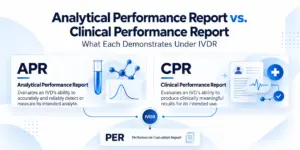
What is the difference between analytical and clinical performance?
- Analytical performance evaluates how well the test technically measures the analyte (e.g., LoD, precision, interference).
- Clinical performance evaluates how well the test correlates with a clinical condition or outcome.
Both are essential for most IVD submissions.
How often should IVD regulatory documents be updated?
Documents should be updated when there are:
- Design changes
- New indications or claims
- Regulatory updates
- New performance data
- Manufacturing changes
- Post-market findings
- Safety issues or complaints
What are best practices for writing IVD IFUs?
Best practices include:
- Using clear and concise language
- Following regulatory labeling requirements
- Including warnings and limitations
- Using readable formatting
- Validating translations
- Aligning instructions with actual workflow
- Avoiding unsupported claims
How do regulatory writers work with cross-functional teams?
Regulatory writers often collaborate with:
- Regulatory Affairs
- Clinical Affairs
- R&D
- Quality Assurance
- Biostatistics
- Medical Affairs
- Manufacturing
- Marketing
The writer consolidates technical input into compliant, submission-ready documentation.
How important is consistency across documents?
Consistency is critical. Inconsistencies in claims, indications, data, or terminology can trigger regulatory questions and delays. Regulatory writers help ensure harmonization across all submission materials.
What trends are shaping IVD regulatory writing today?
Current trends include:
- EU IVDR implementation challenges
- Increased clinical evidence expectations
- AI/ML-enabled diagnostics
- Companion diagnostics growth
- Cybersecurity and software documentation
- Greater emphasis on usability and human factors
- Real-world evidence integration
- Global harmonization efforts