Author: Sarah VanVickle Chaves, Director of IVD and Scientific Writing Services, Ph.D. Molecular and Cellular Biology
For medical device and in vitro diagnostic (IVD) manufacturers, a systematic literature review (SLR) is only as defensible as the search strategy behind it.
A search may return hundreds—or thousands—of publications. But volume does not demonstrate rigor. Regulators and Notified Bodies need to understand how the evidence was identified, whether the search was sufficiently comprehensive, and whether another qualified reviewer could reproduce the process.
This makes search strategy development a critical part of literature reviews supporting Clinical Evaluation Reports (CERs), Performance Evaluation Reports (PERs), state-of-the-art (SOTA) assessments, post-market clinical follow-up (PMCF), post-market performance follow-up (PMPF), and other clinical evidence activities.
Under the EU Medical Device Regulation (MDR), manufacturers must identify available clinical data and clinical evidence gaps through a systematic scientific literature review. The regulation also identifies the methodology for the literature search and relevant literature-search documentation among the elements assessed by Notified Bodies. The In Vitro Diagnostic Medical Devices Regulation (IVDR) establishes a similar expectation in Annex XIII for performance evaluation.
The question, then, is not simply: “Did you search the literature?” It is: “Can you demonstrate that your search was systematic, appropriate, transparent, and reproducible?” That starts with the search string.
What Is a Reproducible Search Strategy?
A reproducible search strategy provides enough information for another appropriately qualified person to understand how the search was constructed and, ideally, rerun it in the same database with substantially the same results, accounting for changes in database content and indexing over time.
A reproducible search should capture, as applicable: the database and search platform; date searched; date range covered; search concepts; controlled vocabulary terms such as MeSH or Emtree; free-text terms and synonyms; Boolean and proximity operators; truncation and wildcard conventions; field restrictions; filters and limits; the complete search string as executed; and the number of records retrieved.
For regulatory literature reviews, this documentation creates an audit trail connecting the review question to the evidence ultimately included in the CER or PER. Systematic literature review support can help manufacturers establish a structured, transparent, and reproducible approach to literature searching and evidence identification.
Why Search Methodology Matters Under the MDR
MDR Annex XIV requires manufacturers to identify available clinical data relevant to the device and its intended purpose—and identify gaps in the clinical evidence—through a systematic scientific literature review. The regulation also requires manufacturers to appraise relevant clinical data and analyze the totality of that evidence to reach conclusions regarding safety, clinical performance, and clinical benefits.
This makes literature identification the foundation for everything that follows. If a relevant publication is never identified because the search strategy was too narrow, it cannot subsequently be screened, appraised, weighted, or incorporated into the clinical evaluation.
This is particularly important because MDR Annex XIV expects clinical evaluation to be thorough and objective and to consider both favorable and unfavorable data. Search methodology therefore has a direct relationship to potential evidence-selection bias.
The MDR also makes the importance of search methodology clear from a conformity-assessment perspective: Notified Body review of the clinical evaluation includes the methodology for the literature search and relevant literature-search documentation.
The IVDR Raises Similar Expectations
For IVD manufacturers, systematic literature searching can be particularly important when developing evidence supporting scientific validity and clinical performance.
IVDR Annex XIII establishes performance evaluation around three elements: scientific validity, analytical performance, and clinical performance. As a general methodological principle, manufacturers must identify relevant available data through a systematic scientific literature review, appraise those data, and generate additional data where necessary to address outstanding issues.
A poorly constructed search can therefore affect more than the literature review itself. If the search does not adequately capture literature describing the association of an analyte with a clinical condition or physiological state, for example, the resulting evidence package may provide an incomplete picture of scientific validity.
Start With the Regulatory Question—not the Database
One of the most common search-development mistakes is opening PubMed and immediately beginning to type keywords. The search should instead begin with the question the literature review needs to answer.
For a medical device CER, questions may address device safety and clinical performance, equivalent or similar technologies, complications and adverse events, current state of the art, alternative treatment options, and accepted safety or performance benchmarks. For an IVDR PER, questions may focus on scientific validity, clinical performance, diagnostic alternatives, and current performance benchmarks.
These are different questions, and they may require different search strategies.
One Search String Does Not Necessarily Answer Every Regulatory Question
A device-specific search might focus on device name, manufacturer, generic technology, and indication. A state-of-the-art search may instead focus on disease or condition, treatment or diagnostic modality, and clinical outcomes. An adverse-event search may require additional safety terminology, while an IVD scientific-validity search may center on analyte or marker, disease or clinical condition, and association.
Trying to force all of these concepts into one search string can unintentionally make the search so restrictive that relevant evidence disappears. A systematic search strategy should therefore be designed around the regulatory objective—not around the assumption that fewer searches are inherently better.
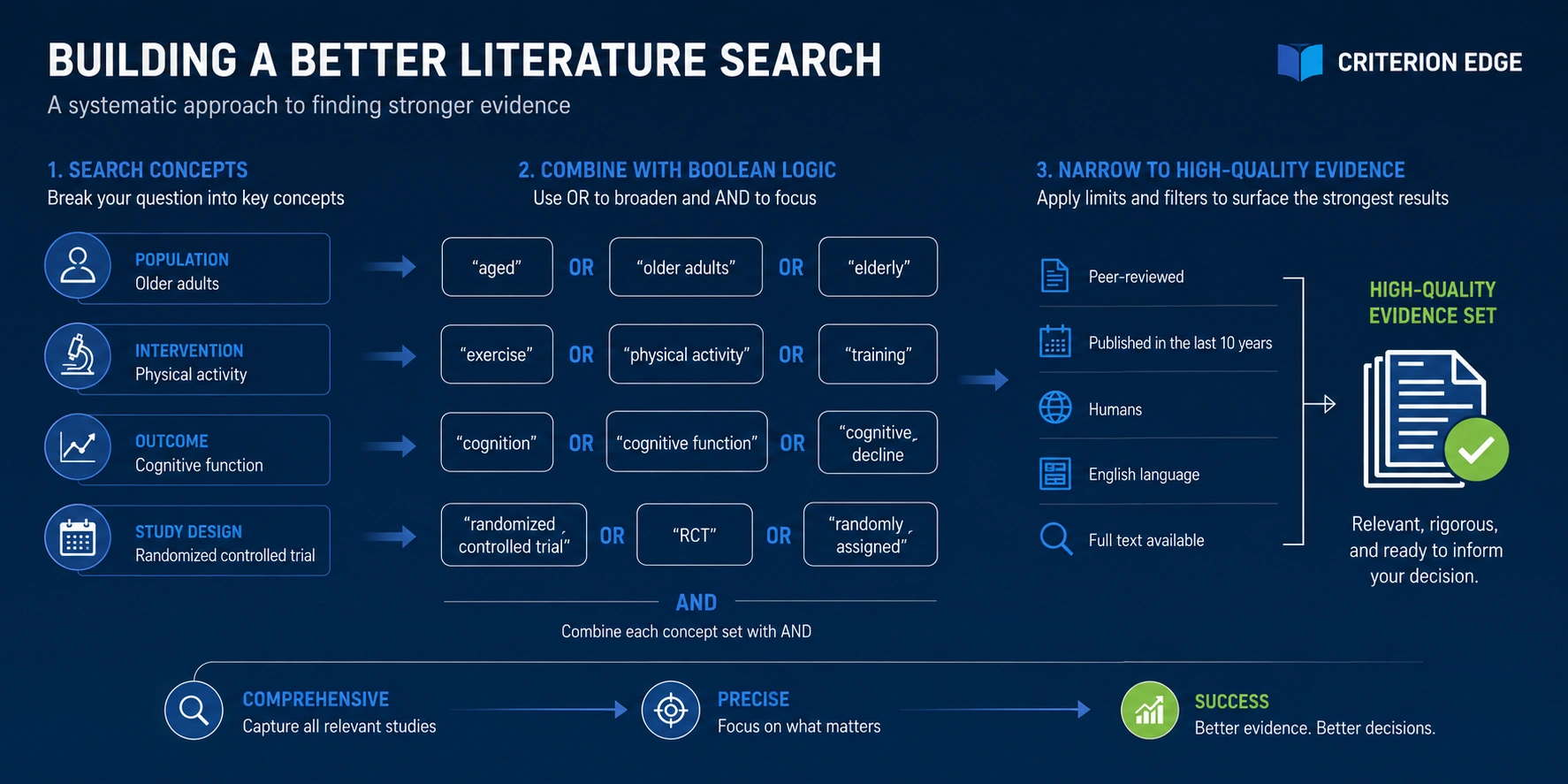
Step 1: Translate the Review Question Into Search Concepts
Frameworks such as PICO can be helpful: Population, Intervention/device, Comparator, and Outcome. However, PICO should not be applied mechanically.
Cochrane cautions that it may be unnecessary—or undesirable—to search every component of a clinical question because concepts such as comparators and outcomes may not appear in article titles or abstracts and may be inconsistently indexed.
For example, rather than requiring Condition X AND Device Y AND medical management AND symptom improvement, a more sensitive strategy may initially focus on Condition X AND Device Y, with comparator and outcome requirements handled during screening.
Step 2: Build a Concept Table
Before writing Boolean syntax, develop a terminology table for each concept. The goal is to identify the different ways authors and indexers may describe the same concept. Cochrane recommends using both controlled vocabulary and free-text terms when developing systematic-review searches.
| Concept | Controlled Vocabulary | Free-Text Terms |
| Condition X | Relevant MeSH/Emtree heading | condition X; alternate disease name; abbreviation |
| Device/Technology | Relevant device heading, if available | trade name; generic name; technology name; model/family |
| Procedure | Relevant procedure heading | procedure name; procedural synonyms; abbreviations |
Step 3: Account for Device Naming Variability
Medical devices can be unusually challenging to search because a single technology may be described by commercial or trade name, manufacturer name, previous manufacturer name, generic device name, product family, model number, technology class, procedural name, abbreviation, previous product name, or descriptive terminology rather than a formal device name.
A search based only on a current trade name may therefore miss important evidence. Terminology development should account for the device’s naming history and technology.
Step 4: Combine Synonyms With OR
Within each concept, related terms are generally combined using OR. For example: (“myocardial infarction” OR “heart attack” OR “myocardial infarct” OR MI). OR increases sensitivity by retrieving records containing any of the included alternatives.
Potential sources of terminology include device labeling and IFU, clinical investigation documentation, previous CERs or PERs, known pivotal publications, guidelines, MeSH, Emtree, competitor terminology, scoping searches, and state-of-the-art literature.
Step 5: Combine Concepts With AND
Once synonyms have been grouped within concepts using OR, separate concepts are typically combined with AND. The distinction is fundamental: OR broadens within a concept; AND intersects different concepts.
Incorrect Boolean logic can significantly change search results, which is why the PRESS guideline for peer review of electronic search strategies specifically includes Boolean and proximity operators among the elements that should be reviewed.
Step 6: Use Controlled Vocabulary and Free Text Together
PubMed/MEDLINE uses Medical Subject Headings (MeSH), while Embase uses Emtree. Controlled vocabulary can identify publications discussing the same concept even when authors use different terminology.
Controlled vocabulary alone is generally insufficient. New publications may not yet be fully indexed, new technologies may not have dedicated subject headings, and device names may not map neatly to controlled vocabulary. A robust strategy therefore commonly combines subject headings with free-text terminology.
Step 7: Use Truncation and Wildcards Carefully
Truncation can efficiently capture multiple forms of a word. For example, implant* may retrieve implant, implants, implanted, implantation, and implantable. This can improve efficiency, but overly broad truncation can introduce substantial noise.
Syntax varies between databases, so a reproducible review should document the actual database-specific strategy executed rather than simply stating that the same search was used everywhere.
Step 8: Consider Proximity Searching
Some databases allow proximity operators that retrieve words appearing within a specified distance of each other. Proximity searching can improve precision without imposing the rigidity of an exact phrase, but syntax is platform-specific. PRESS includes proximity operators among the components that should be reviewed when evaluating electronic search strategies.
Step 9: Be Cautious With Filters and Limits
Search limits can make results more manageable, but every restriction potentially removes evidence. Examples include language, humans only, publication date, article type, age group, and study-design filters. Each should have a defensible rationale tied to the review protocol and regulatory objective.
For a regulatory literature review, an arbitrary five-year limit could be difficult to justify if important device-specific evidence was published earlier. A SOTA update may legitimately emphasize recent literature, while a device-specific clinical evidence search may need to extend back to the device’s earliest clinical use.
Sensitivity vs. Precision: Finding the Right Balance
Sensitivity asks: of all relevant studies that exist, how many did the search retrieve? Precision asks: of all records retrieved, how many are actually relevant?
For systematic reviews, missing relevant evidence is generally the greater methodological concern. Cochrane therefore recommends aiming for high sensitivity even when precision is relatively low. In medical device regulatory work, the balance should also consider the risk of missing evidence that could affect safety, performance, benefit-risk, SOTA benchmarks, adverse events, equivalence, or clinical evidence gaps.
Test the Search Against Known Relevant Publications
One practical quality check is to ask whether the search retrieves publications already known to be relevant. If an important known publication is missing, investigate why. Device terminology, disease terminology, indexing, filters, or Boolean structure may need to be revised.
Known articles should be used to test the strategy—not to engineer a search designed only to retrieve a predetermined evidence set.
Consider Peer Review of the Search Strategy
The PRESS (Peer Review of Electronic Search Strategies) 2015 Guideline was developed to improve electronic search strategies for systematic reviews and other evidence syntheses. PRESS identifies six major elements for review: translation of the research question; Boolean and proximity operators; subject headings; text-word searching; spelling, syntax, and line numbers; and limits and filters.
Peer review is particularly valuable before a strategy is translated across databases because an error in the foundational strategy can otherwise propagate into every subsequent search.
Translate—Don’t Copy—the Search Across Databases
A PubMed search string generally should not simply be copied and pasted into Embase. Databases differ in controlled vocabulary, indexing practices, field codes, phrase-searching behavior, truncation syntax, wildcard conventions, proximity operators, and filters.
The conceptual logic can remain consistent, but the actual syntax should be adapted to each database. A reproducible literature review should preserve each database-specific strategy as it was executed.
Document the Search at the Time It Is Run
Do not rely on reconstructing the search months later when the CER or PER is being finalized. For each database, record the database, platform, search date, coverage, complete strategy exactly as executed, all limits, and the number of records retrieved.
PRISMA-S—the PRISMA extension specifically addressing literature searches—provides a 16-item reporting checklist intended to improve transparency and reproducibility in reporting systematic-review searches. For CERs and PERs, PRISMA-S can provide a useful reporting framework alongside the applicable regulatory methodology.
A Reproducible Search String Is More Than the String Itself
A reproducible search strategy is not merely a reproducible Boolean expression. Reproducibility depends on the search string plus its execution context: database, platform, search date, date range, automatic term mapping behavior, filters, supplemental searching, and result count.
Common Search Strategy Problems That Can Undermine a Regulatory Review
Search Problem 1: Searching Only the Device Trade Name
Risk: Missing publications that use generic terminology, previous names, manufacturer names, or procedural terminology. Better approach: develop a documented terminology concept reflecting device naming history and technology.
Search Problem 2: Requiring Too Many Concepts
Risk: Excessive AND operators can dramatically reduce sensitivity. Better approach: search the concepts most likely to appear consistently in titles, abstracts, and indexing; apply other eligibility criteria during screening where appropriate.
Search Problem 3: Using Only Keywords
Risk: Relevant indexed literature using unexpected terminology may be missed. Better approach: combine controlled vocabulary with free-text terminology.
Search Problem 4: Using Only Controlled Vocabulary
Risk: New, incompletely indexed, or device-specific records may be missed. Better approach: supplement subject headings with synonyms, trade names, generic names, abbreviations, and other free-text terms.
Search Problem 5: Copying One Search Across Every Database
Risk: Database-specific syntax or controlled vocabulary may not translate correctly. Better approach: translate the conceptual strategy for each database and preserve the final executed version.
Search Problem 6: Applying Unjustified Date or Language Limits
Risk: Relevant evidence may be excluded before screening. Better approach: tie restrictions to the review protocol and regulatory objective and document the rationale.
Search Problem 7: Reconstructing Search Documentation Afterward
Risk: Dates, strings, filters, result counts, and strategy revisions may be inaccurate. Better approach: capture the complete search record contemporaneously.
What Should Be in a Regulatory Literature Search Protocol?
| Element | What to Define |
| Review objective | Regulatory question the search will address |
| Scope | Device, indication, population, claims, SOTA, safety, performance, etc. |
| Information sources | Databases and supplemental sources |
| Search concepts | Core concepts derived from the review question |
| Terminology | Controlled vocabulary, keywords, synonyms, trade/generic names |
| Search logic | AND, OR, NOT, proximity, truncation, field searching |
| Date coverage | Beginning and end of the search period |
| Limits | Language, humans, study type, dates, etc., with rationale |
| Eligibility criteria | Predefined inclusion and exclusion criteria |
| Search validation | Known relevant articles or other strategy checks |
| Documentation | Exact database-specific strings and results |
| Updates | Method for rerunning searches during CER/PER updates |
Search Reproducibility Matters Even More During CER and PER Updates
Clinical and performance evaluation are lifecycle activities. A search performed for an initial CER may later need to be updated for periodic CER revision, PMCF, PMS, SSCP updates, design or labeling
changes, new indications, emerging safety signals, or Notified Body questions. IVDR literature reviews likewise may need updates as scientific validity, clinical performance, SOTA, or PMPF evidence evolves.
If the original search is fully documented, updates can preserve the methodology, revise date limits, account for terminology or indexing changes, rerun the strategy, deduplicate against the prior evidence set, and screen newly identified literature. If the original documentation says only “PubMed was searched,” the update becomes much harder to defend.
The Search Strategy Should Be Traceable Through the Entire Review
The complete evidence pathway should be traceable from regulatory question to search protocol, database-specific strategies, records retrieved, deduplication, title/abstract screening, full-text screening, critical appraisal, evidence synthesis, and ultimately CER/PER conclusions.
This is where well-designed search methodology connects with PRISMA-style reporting and regulatory clinical evaluation methodology. PRISMA-S provides guidance specifically for reporting searches, while the broader regulatory framework determines what the resulting evidence must demonstrate.
Search Strategy Development Is Both a Scientific and Regulatory Skill
Search strings can look deceptively simple. A few parentheses, Boolean operators, and keywords may create the appearance of systematic methodology. But a defensible regulatory search requires understanding the device, intended purpose, regulatory claims, clinical terminology, device naming history, indexing systems, database functionality, SOTA, evidence hierarchy, regulatory objectives, and how the search will ultimately feed the CER or PER.
Cochrane recommends involving experienced medical or healthcare librarians or information specialists in the search process from the protocol stage.
The Bottom Line
For medical device and IVD systematic literature reviews, a good search strategy is not simply one that retrieves a manageable number of articles. It should be sufficiently sensitive, scientifically justified, transparent, and reproducible.
The MDR explicitly requires systematic scientific literature review as part of clinical evaluation and identifies literature-search methodology and documentation as areas for Notified Body assessment. The IVDR similarly requires systematic literature review as a methodological component of performance evaluation.
Standards such as PRISMA-S, PRESS, and the Cochrane Handbook provide complementary methodological tools for making those searches more transparent, robust, and reproducible. The goal is not to create the longest or most sophisticated-looking search string. It is to create a search strategy that is fit for its regulatory purpose, scientifically defensible, reproducible, and traceable from the original question to the final clinical evidence conclusions.
How Criterion Edge Can Help
Developing a systematic literature search for a medical device or IVD requires more than familiarity with PubMed.
Criterion Edge’s medical device writing services include systematic literature review support from experienced writers and medical librarians, including literature searching and screening, PRISMA
flowcharts, evidence weighting and appraisal, literature review reports, data extraction and analysis, and post-market literature surveillance.
A structured approach can help manufacturers establish search strategies that are reproducible, maintainable, and aligned with the clinical or performance evaluation they are intended to support.
References and Regulatory Resources
- Regulation (EU) 2017/745 (EU MDR) — Article 61 and Annex XIV, Clinical Evaluation and Post-Market Clinical Follow-up. European Parliament and Council. https://eur-lex.europa.eu/eli/reg/2017/745/2017-05-05
- Regulation (EU) 2017/746 (EU IVDR) — Annex XIII, Performance Evaluation, Performance Studies and Post-Market Performance Follow-up. European Parliament and Council. https://eur-lex.europa.eu/eli/reg/2017/746/oj/eng
- Cochrane Handbook for Systematic Reviews of Interventions, Chapter 4: Searching for and Selecting Studies. https://www.cochrane.org/authors/handbooks-and-manuals/handbook/current/chapter-04
- McGowan J, Sampson M, Salzwedel DM, Cogo E, Foerster V, Lefebvre C. PRESS Peer Review of Electronic Search Strategies: 2015 Guideline Statement. Journal of Clinical Epidemiology. 2016;75:40-46. https://pubmed.ncbi.nlm.nih.gov/27005575/
- PRISMA-S: An Extension to the PRISMA Statement for Reporting Literature Searches in Systematic Reviews. https://www.prisma-statement.org/prisma-search
- Criterion Edge — Medical Device Writing Services and Systematic Literature Reviews. https://criterionedge.com/medical-device/
This article is intended for general informational purposes and does not constitute regulatory or legal advice. Manufacturers should determine the requirements and methodology appropriate to their specific device, intended purpose, evidence base, conformity assessment route, and regulatory strategy.