Author: Sarah Chavez, Director of IVD and Scientific Writing Services
For medical device and IVD manufacturers, literature reviews are much more than background research. They are an important component of the clinical evidence used to support a Clinical Evaluation Report (CER) under the EU Medical Device Regulation (MDR) and a Performance Evaluation Report (PER) under the EU In Vitro Diagnostic Medical Devices Regulation (IVDR).
As expectations for clinical evidence have increased, manufacturers may hear another phrase increasingly often: “PRISMA-compliant literature review.”
But what does PRISMA compliance actually mean in the context of a CER or PER? Does the MDR or IVDR require PRISMA? Is adding a PRISMA flow diagram enough? And how should manufacturers reconcile PRISMA methodology with medical device regulatory requirements?
A strong regulatory literature review can use PRISMA to improve transparency and reproducibility while remaining firmly anchored to MDR, IVDR, MDCG, and applicable regulatory guidance.
What Is PRISMA?
PRISMA stands for Preferred Reporting Items for Systematic Reviews and Meta-Analyses. PRISMA 2020 replaced the original 2009 statement and provides a 27-item checklist, an expanded checklist, an abstract checklist, and flow diagrams for reporting original and updated systematic reviews. [5]
The purpose of PRISMA is transparent reporting. A reader should be able to understand why a review was conducted, what questions it sought to answer, where and how the authors searched, which records were identified, how studies were screened, why studies were excluded, how included evidence was assessed, and how the evidence was synthesized and interpreted.
That objective aligns closely with what regulators and Notified Bodies expect from a defensible medical device literature review: a systematic, objective, transparent, and reproducible approach to identifying and evaluating relevant evidence.
Does the MDR Require PRISMA?
No. Regulation (EU) 2017/745 does not explicitly require manufacturers to follow PRISMA.
Instead, MDR Article 61 requires manufacturers to plan, conduct, and document clinical evaluation in accordance with Article 61 and Annex XIV. The clinical evaluation must support conformity with applicable General Safety and Performance Requirements (GSPRs), with the level of clinical evidence justified based on the device and its intended purpose. [1]
TÜV SÜD similarly describes clinical evaluation as a systematic and planned process for continuously generating, collecting, appraising, analyzing, and evaluating clinical data, and emphasizes that the evaluation should be thorough and objective and consider both favorable and unfavorable clinical data. [7]
Accordingly, a more precise statement is that PRISMA can provide a recognized framework for documenting the systematic literature review that contributes evidence to an MDR clinical evaluation.
MEDDEV 2.7/1 Rev. 4 Makes the Connection Even Clearer
Although MEDDEV 2.7/1 Rev. 4 predates the MDR, it continues to be referenced in MDCG guidance where relevant. MDCG 2020-6, for example, identifies MEDDEV 2.7/1 Rev. 4 as a reference document for clinical evaluation of legacy devices. [4]
MEDDEV 2.7/1 Rev. 4 describes clinical evaluation as a staged process that includes defining the scope of the clinical evaluation; identifying pertinent clinical data; appraising the pertinent data; analyzing the data; and documenting the conclusions. Its sections specifically address data retrieved from literature, appraisal plans, methodological quality, and scientific validity. [3]
These principles overlap significantly with systematic-review practices reflected in PRISMA. The frameworks, however, serve different purposes: MEDDEV/MDR tells manufacturers what their clinical evaluation needs to accomplish from a regulatory perspective, while PRISMA helps demonstrate transparently how a systematic review was conducted and reported.
What About the IVDR and PERs?
For IVDs, the regulatory connection to structured literature review methodology is arguably even more explicit.
Under Regulation (EU) 2017/746, performance evaluation is based on three interconnected elements: scientific validity, analytical performance, and clinical performance. IVDR Article 56 requires manufacturers to plan, conduct, and document performance evaluation using a defined and methodologically sound procedure. [2]
Annex XIII identifies documentation including the literature search methodology, literature search protocol, and literature search report of a literature review, together with the justification for the approach used to gather clinical evidence. [2]
That does not make PRISMA mandatory. It does, however, make documented, methodologically sound, and reproducible systematic literature reviews highly relevant to IVDR compliance. BSI has also highlighted the importance of robust literature evidence under IVDR, particularly for demonstrating scientific validity and state of the art. [8]
So, What Does “PRISMA-Compliant” Actually Mean?
For a CER or PER literature review, calling the review “PRISMA-compliant” should mean more than inserting a flowchart showing how many publications were found. A defensible PRISMA-aligned review should allow another qualified reviewer—or a Notified Body assessor—to understand exactly how the evidence base was created.
A Clearly Defined Review Question and Scope
Before searching, the manufacturer should establish what the literature review is intended to answer. For a CER, that can include safety and clinical performance, clinical benefits, device-specific evidence, equivalent or similar devices, known risks and adverse events, alternative treatments or technologies, state
of the art, and gaps in the available clinical evidence. For a PER, literature questions may additionally address scientific validity and relevant clinical performance considerations. The scope should connect directly to intended purpose, indications, target population, device characteristics, claims, risks, and applicable endpoints.
A Prospectively Defined Literature Search Protocol
The literature search methodology should not appear to have been constructed after reviewers already knew which papers they wanted to include. The protocol should establish, as applicable, research questions, databases, search dates and coverage periods, search concepts and terminology, Boolean operators and search strings, inclusion and exclusion criteria, language or publication restrictions and their justification, screening procedures, duplicate handling, appraisal methodology, and the approach to data extraction and synthesis. For IVDR PERs, documenting the literature search methodology, protocol, and report is directly reflected in Annex XIII. [2]
Reproducible Search Strategies
Statements such as “A PubMed search was conducted for relevant clinical literature” are generally insufficient for a truly transparent systematic review. A reproducible literature search should document enough information for another reviewer to understand—and, where practical, recreate—the search. Useful elements include the database, search date, date coverage, complete Boolean search strategy, filters, and record count.
Predefined Inclusion and Exclusion Criteria
The manufacturer should define why publications qualify—or do not qualify—for the review. Criteria might address device or technology, intended purpose, indication, patient population, comparator, outcomes, study design, publication type, publication date, language, and availability of sufficient methodological information. These criteria should be applied consistently, and the review should consider both favorable and unfavorable data. [7]
Transparent Study Selection
The familiar PRISMA flow diagram is useful for documenting the progression from records identified, through duplicate removal and screening, to full-text assessment, exclusions, and final inclusion. PRISMA 2020 provides templates for both new and updated systematic reviews. [5] For regulatory purposes, the counts in the diagram should reconcile with the underlying search and screening records.
Documented Reasons for Full-Text Exclusion
Simply reporting that a number of full-text publications were excluded is less informative than documenting why they were excluded. Typical reasons can include wrong device or technology, wrong indication or population, absence of relevant safety or performance outcomes, duplicate populations, insufficient clinical information, non-clinical publication, or an excluded publication type. Maintaining a full-text exclusion log creates an important audit trail.
Critical Appraisal—not Just Article Collection
Finding literature is only the beginning. MEDDEV 2.7/1 Rev. 4 separately addresses identification, appraisal, and analysis of pertinent clinical data, including methodological quality and scientific validity. [3] A CER literature review should therefore evaluate methodological soundness, population relevance, device comparability, clinical meaning of endpoints, adequacy of follow-up, bias, relevance to claims, and appropriate evidence weighting.
Evidence Synthesis Linked to Regulatory Questions
PRISMA reporting should not turn the CER or PER into an academic systematic review disconnected from the technical documentation. For an MDR CER, the literature should help determine whether the totality of clinical evidence supports safety, performance, clinical benefit, benefit-risk determination, claims, and conformity with applicable GSPRs. BSI guidance emphasizes linking clinical evidence to relevant GSPRs and the importance of state-of-the-art assessment and repeated literature searches when clinical evaluations are updated. [6] For an IVDR PER, literature evidence should similarly connect to scientific validity, clinical performance, state of the art, intended clinical benefit, and the overall clinical evidence supporting the device.
PRISMA Compliance Is Not the Same as Regulatory Compliance
A literature review could follow every applicable PRISMA reporting item and still be inadequate for a CER or PER. PRISMA primarily addresses transparent reporting of systematic reviews; it does not determine whether the evidence is sufficient to demonstrate conformity with MDR or IVDR requirements.
- the search questions do not correspond to the device’s intended purpose
- the search strategy does not adequately capture the device or state of the art
- relevant unfavorable evidence is omitted
- equivalence is assumed without adequate demonstration
- appraisal criteria are poorly defined
- evidence is not linked to claims or GSPRs
- important clinical risks are not addressed
- the literature is outdated
- evidence gaps are identified but never addressed
The regulatory question is not simply “Did you follow PRISMA?” It is whether the systematic and documented evaluation of the totality of relevant evidence adequately supports the regulatory conclusions being made about the device.
PRISMA Flow Diagram ≠ PRISMA-Compliant Review
One of the most common misconceptions is that including a PRISMA diagram automatically makes a literature review PRISMA-compliant. It does not. The flow diagram is only one component of the PRISMA framework. PRISMA 2020 contains a 27-item checklist addressing the title, abstract, rationale, objectives, eligibility criteria, information sources, search strategy, selection process, data collection, risk-of-bias assessment, synthesis methods, results, discussion, registration, support, competing interests, and availability of materials. [5]
For CER and PER purposes, not every item will necessarily translate directly into the structure of regulatory technical documentation. That is why “PRISMA-aligned” may sometimes be the more precise description unless the review has actually been evaluated against all applicable PRISMA 2020 reporting items.
PRISMA and State-of-the-Art Searches Are Not Necessarily the Same Search
The MDR clinical evaluation framework requires manufacturers to consider current knowledge and state of the art in the relevant medical field. MEDDEV 2.7/1 Rev. 4 describes this as including information on the medical condition, its natural course, benchmark devices, alternative devices, and available medical alternatives. [3] BSI likewise emphasizes reassessing state of the art when CERs are updated. [6]
Consequently, a search designed to identify publications specifically about one device may not adequately establish state of the art. Manufacturers often need distinct—but coordinated—search strategies addressing device-specific evidence and state-of-the-art evidence. For IVDs, state-of-the-art evidence can similarly be essential when establishing scientific validity and interpreting clinical performance.
Literature Reviews Must Be Maintainable
A CER or PER is not a one-time academic publication. Clinical and performance evaluation are lifecycle processes. TÜV SÜD describes MDR clinical evaluation as a continuous process, while IVDR Annex XIII requires clinical evidence and its assessment in the PER to be updated throughout the device lifecycle. [2,7]
This makes reproducibility particularly valuable. When the original search has documented search strings, clearly defined databases, established eligibility criteria, traceable screening decisions, appraisal criteria, and a structured evidence table, an update can build systematically on the previous review rather than becoming a reconstruction exercise.
A Practical Regulatory Standard for a PRISMA-Aligned CER or PER Review
A robust literature review should generally be able to answer the following questions:
| Question | Why It Matters |
| What regulatory question was the search designed to answer? | Establishes relevance to the CER/PER |
| Which databases and other sources were searched? | Demonstrates search breadth |
| When was each search conducted? | Establishes currency |
| What exact search strategies were used? | Supports reproducibility |
| What were the predefined inclusion/exclusion criteria? | Reduces selection bias |
| How were duplicates handled? | Supports accurate accounting |
| How were titles and abstracts screened? | Demonstrates systematic selection |
| Why were full-text publications excluded? | Creates an audit trail |
| How was methodological quality assessed? | Supports evidence weighting |
| Were favorable and unfavorable data considered? | Supports objectivity |
| How does each publication relate to the device, claims, risks, and intended purpose? | Establishes regulatory relevance |
How does the evidence compare with state of the art? | Supports benefit-risk and clinical context |
Can the search be reproduced and updated? | Supports lifecycle clinical/performance evaluation |
A PRISMA flow diagram complements this documentation—it does not replace it.
The Bottom Line
For CERs and PERs, “PRISMA-compliant” should describe transparency and systematic reporting—not serve as shorthand for regulatory compliance.
Neither MDR nor IVDR simply says “follow PRISMA.” Instead, the regulations establish requirements for systematic, scientifically sound, objective, and continuously maintained clinical or performance evaluation. MDR guidance and Notified Body expectations further reinforce the importance of identifying, appraising, analyzing, and maintaining relevant clinical evidence. [1–4,6–8]
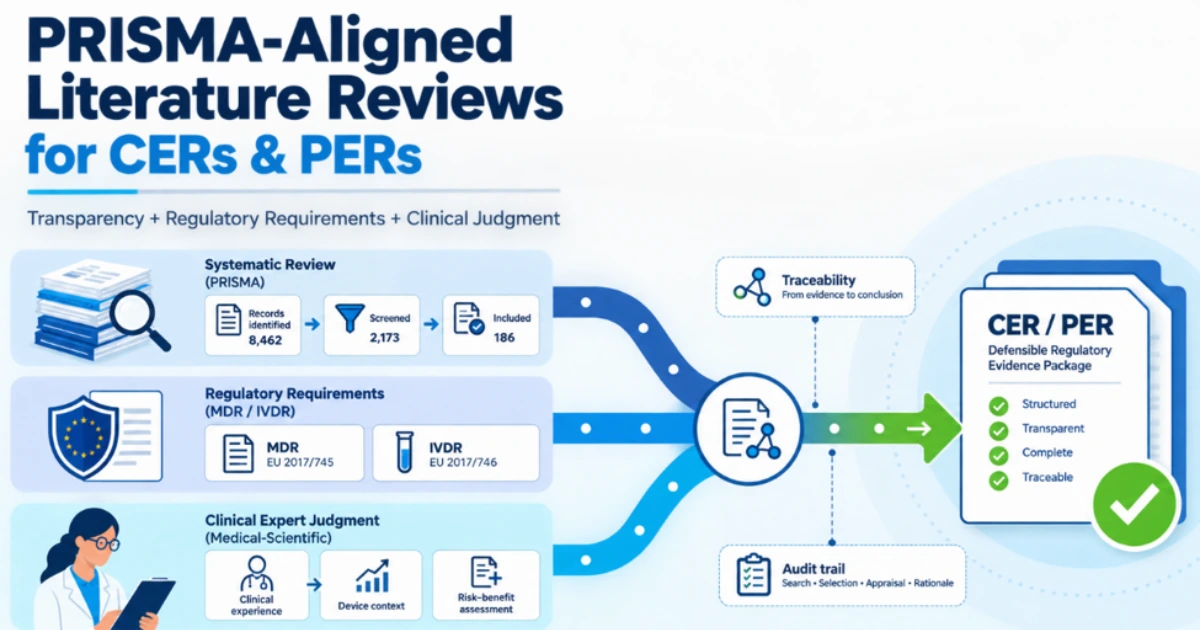
The strongest approach is: PRISMA-informed systematic review methodology + MDR/IVDR regulatory requirements + device-specific clinical judgment.
When those elements are integrated correctly, the literature review becomes more than a search report or a flow diagram. It becomes a traceable and defensible component of the clinical evidence package supporting the CER or PER.
How Criterion Edge Can Help
Preparing a regulatory literature review requires more than running database searches. Search methodology must align with the device’s intended purpose, claims, risks, clinical evidence strategy, and applicable regulatory requirements—and the resulting evidence must remain traceable from identification through appraisal and analysis.
Criterion Edge supports medical device and IVD manufacturers with regulatory and scientific writing activities, including literature review and clinical/performance evaluation documentation. A structured, reproducible literature review can help manufacturers create CER and PER evidence packages that are easier to maintain, update, and defend during regulatory review.
References and Regulatory Resources
- Regulation (EU) 2017/745 (MDR) — Article 61 and Annex XIV concerning clinical evaluation. Source
- Regulation (EU) 2017/746 (IVDR) — Article 56 and Annex XIII concerning performance evaluation and clinical evidence. Source
- European Commission, MEDDEV 2.7/1 Rev. 4 — Clinical Evaluation: A Guide for Manufacturers and Notified Bodies. Source
- MDCG 2020-6 — Guidance on Sufficient Clinical Evidence for Legacy Devices. Source
- PRISMA 2020 Statement — Preferred Reporting Items for Systematic Reviews and Meta-Analyses. Source
- BSI — Best Practice Guidance on Clinical Evaluation. Source
- TÜV SÜD — Clinical Evaluation of Medical Devices. Source
- BSI — The Realities of Clinical and Performance Evidence for IVDs under the IVDR. Source
Disclaimer: This article is intended for general informational purposes and does not constitute regulatory or legal advice. Manufacturers should determine the requirements applicable to their specific device, intended purpose, classification, conformity assessment route, and regulatory strategy.