Author: Sarah Chavez, Director of IVD and Scientific Writing Services
For manufacturers accustomed to preparing medical device technical documentation under the EU Medical Device Regulation (MDR), an In Vitro Diagnostic Regulation (IVDR) submission can initially look familiar. Both Regulations organize technical documentation around device description, labeling, design and manufacturing, General Safety and Performance Requirements (GSPRs), risk management, and verification and validation.
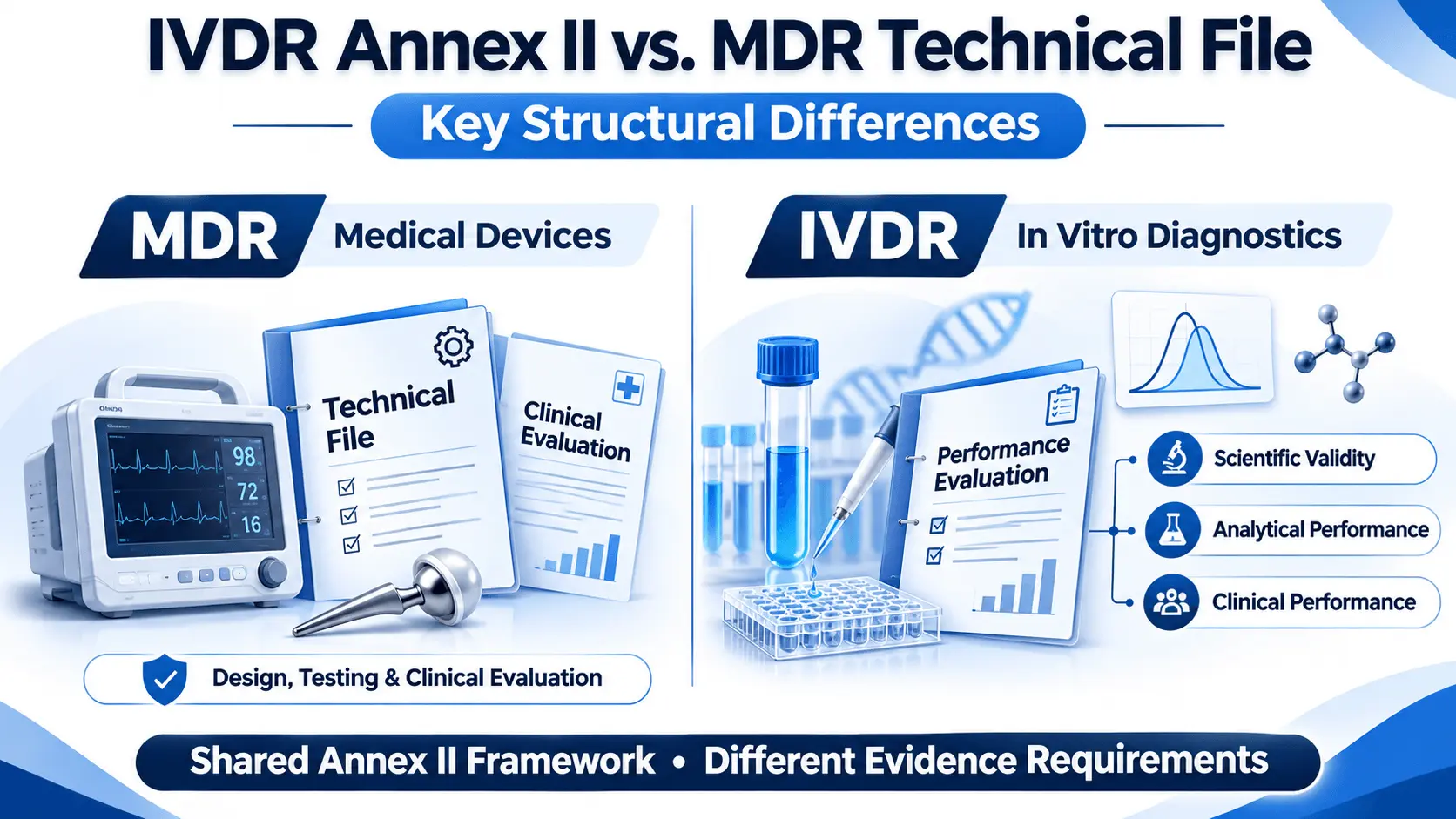
But that similarity can be deceptive. An IVDR technical documentation package should not be treated as an MDR technical file with the terminology changed. The evidence architecture is substantially different because an IVD must demonstrate the relationship between an analyte or marker, analytical performance, clinical performance, and the device’s intended clinical purpose.
Understanding that difference is critical when building technical documentation that is complete, internally consistent, and easy for a notified body to review.
MDR and IVDR Technical Documentation: Similar Framework, Different Evidence
At the highest level, MDR Annex II and IVDR Annex II follow a remarkably similar six-part structure:
| Technical Documentation Section | MDR | IVDR |
| 1. Device description and specification | Yes | Yes |
| 2. Information supplied by manufacturer | Yes | Yes |
| 3. Design and manufacturing information | Yes | Yes |
| 4. General Safety and Performance Requirements | Yes | Yes |
| 5. Benefit-risk analysis and risk management | Yes | Yes |
| 6. Product verification and validation | Yes | Yes |
Both Regulations also require technical documentation to be presented in a clear, organized, readily searchable, and unambiguous manner. The major difference appears when you move beneath those headings.
For an MDR device, verification and validation is heavily influenced by the physical and clinical characteristics of the medical device – for example, biocompatibility, electrical safety, mechanical testing, sterilization, software validation, and clinical evaluation.
For an IVD, the evidence package revolves much more explicitly around scientific validity, analytical performance, clinical performance, specimen-related factors, assay characteristics, and stability. That distinction affects how the entire technical documentation package should be written and cross-referenced.
Intended Purpose Becomes the Backbone of the IVDR File
Under the MDR, the device description includes the intended purpose, intended patient population, indications, contraindications, warnings, principles of operation, classification, and other characteristics.
IVDR Annex II requires a more diagnostically focused intended-purpose description. Depending on the device, this may identify:
- what is detected or measured;
- the device’s function, such as screening, monitoring, diagnosis, aid to diagnosis, prognosis, prediction, or companion diagnostic;
- the specific disorder, condition, or risk factor the device is intended to detect, define, or differentiate;
- whether the test is qualitative, semi-quantitative, or quantitative;
- the specimen type;
- the testing population;
- the intended user; and
- whether the device is intended for self-testing or near-patient testing.
TÜV SÜD’s presentation of IVDR Annex II reflects these IVD-specific requirements directly. This means the intended purpose should not simply be treated as introductory text. It becomes a central control point for the technical documentation.
The claims made in the intended purpose should align with the labeling, risk management file, analytical performance evidence, clinical performance evidence, performance evaluation report (PER), and post-market activities. BSI specifically recommends maintaining intended-use consistency throughout the file, including the IFU, risk management documentation, performance evaluation report, and design requirements.
IVDR Design Information Is More Assay-Specific
Another structural difference appears in Section 3. MDR Annex II broadly requires information that allows the design stages applied to the medical device to be understood, along with manufacturing processes, validation, monitoring, final product testing, and identification of relevant manufacturing sites.
IVDR Annex II Section 3.1 goes further into the diagnostic design itself. For example, the technical documentation may need to describe critical ingredients such as antibodies, antigens, enzymes, and nucleic-acid primers. The required information reflects the fact that an IVD’s performance may depend on reagent
formulation, biological components, assay architecture, specimen handling, calibration, controls, instrumentation, and other analytical variables.
For regulatory writers, this has a practical consequence: the design history cannot be described independently of the analytical principle of the assay.
Verification and Validation Is Where MDR and IVDR Diverge Most
Section 6 is where the structural differences become particularly significant. Under IVDR Annex II, product verification and validation documentation specifically addresses analytical performance, clinical performance and clinical evidence, stability, software verification and validation where applicable, and additional information required in specific cases.
Analytical Performance
For an IVD, analytical performance can include characteristics such as:
- analytical sensitivity;
- analytical specificity;
- trueness/bias;
- precision, including repeatability and reproducibility;
- accuracy;
- limits of detection and quantitation;
- measuring range;
- linearity;
- assay cut-off;
- specimen handling;
- endogenous and exogenous interference;
- cross-reactivity; and
- metrological traceability, where applicable.
BSI’s IVDR technical documentation guidance highlights these types of analytical-performance evidence and notes that characteristics considered not applicable should be appropriately justified. That creates a substantially different verification-and-validation narrative from that typically encountered for many MDR devices.
Performance Evaluation Replaces the MDR Clinical-Evaluation Paradigm
One of the most important conceptual differences between MDR and IVDR documentation is the evidence model. Under the IVDR, performance evaluation is a continuous process used to assess and analyze data demonstrating:
- Scientific validity
- Analytical performance
- Clinical performance
These three pillars generate the clinical evidence supporting the IVD.
Scientific Validity
Scientific validity addresses the association of an analyte or marker with a clinical condition or physiological state. Evidence may come from sources such as peer-reviewed scientific literature, information concerning devices measuring the same analyte or marker, expert consensus, proof-of-concept studies, or clinical performance studies.
Analytical Performance
Analytical performance asks a different question: Can the device reliably detect or measure what it claims to detect or measure? The analytical performance report documents the evidence answering that question.
Clinical Performance
Clinical performance considers the device’s ability to yield results correlated with a particular clinical condition or physiological or pathological process or state, in accordance with its intended purpose. IVDR Annex XIII provides that clinical performance may be demonstrated through clinical performance studies, peer-reviewed scientific literature, published experience from routine diagnostic testing, or an appropriate combination of sources. Clinical performance studies are expected unless reliance on other sources can be duly justified.
The Performance Evaluation Report
The resulting PER brings the evidence streams together. BSI describes the PER as including the individual reports covering scientific validity, analytical performance, and clinical performance, which collectively support assessment against applicable GSPRs and constitute the clinical evidence for the device. This is not simply an IVDR version of an MDR Clinical Evaluation Report (CER). The structure and evidence questions are different and should be planned accordingly.
Stability Has Greater Structural Prominence Under IVDR
Stability is another area where an IVD file typically requires particularly deliberate documentation. IVDR Annex II Section 6.3 addresses:
- claimed shelf life;
- in-use stability; and
- shipping stability.
For claimed shelf life, Annex II specifies stability testing using at least three different lots manufactured under conditions essentially equivalent to routine production. Accelerated or extrapolated data may support an initial shelf-life claim, but real-time studies must follow.
For IVD manufacturers, stability therefore needs to be integrated into the regulatory evidence strategy rather than treated as a supporting test report added near the end of technical documentation assembly.
Annex III Makes the Technical Documentation a Lifecycle File
Technical documentation does not end with Annex II. IVDR Article 10 requires manufacturers to draw up and keep technical documentation up to date and specifies that it include the elements set out in Annexes II and III.
Annex III covers post-market surveillance technical documentation. Performance evaluation is similarly a lifecycle activity. IVDR Article 56 requires performance evaluation documentation to be updated throughout the device lifecycle using information obtained through PMPF and post-market surveillance. For Class C and D devices, the PER must be updated when necessary and at least annually.
Strong IVDR technical documentation makes those relationships visible.
Notified Body Reviewability Matters
Compliance is not only about possessing the required evidence. Reviewers must be able to find and understand it. BSI has identified two recurring reasons for delays in IVDR technical documentation review:
- incomplete submissions; and
- poor structuring that makes existing information difficult to locate.
BSI’s recommended organization closely follows Annex II, separating the documentation into logical parts covering device description, manufacturer-supplied information, design and manufacturing, GSPRs, benefit-risk/risk management, analytical performance, clinical performance and clinical evidence, stability, software verification and validation, and other applicable information.
For regulatory teams, that is an important reminder: traceability and navigation are themselves part of submission quality. A technically correct report buried inside an inconsistent or poorly indexed submission can still create avoidable questions and review cycles.
IVDR GSPR Checklist
IVDR Annex I establishes the General Safety and Performance Requirements. Annex II Section 4 requires the manufacturer to identify which requirements apply, explain why requirements are not applicable where appropriate, identify the methods used to demonstrate conformity, identify applicable harmonized standards, Common Specifications (CS), or other solutions, and precisely identify and cross-reference the controlled evidence demonstrating conformity.
The following high-level checklist can be used when building or reviewing an IVDR GSPR matrix. It should be expanded to the individual clauses and subclauses applicable to the specific device.
Chapter I – General Requirements
- GSPR 1 – Performance, safety, and intended purpose: Evidence demonstrates that the device achieves its intended performance and is safe and effective under normal conditions of intended use.
- GSPR 2 – Risk reduction: Risks have been reduced as far as possible without adversely affecting the benefit-risk ratio.
- GSPR 3 – Risk management system: A documented, maintained, lifecycle risk-management system has been established.
- GSPR 4 – Risk-control measures: Risk controls follow the required hierarchy, beginning with inherently safe design and manufacture where possible.
- GSPR 5 – Use-related risks: Risks associated with reasonably foreseeable misuse and ergonomic/usability characteristics have been addressed.
- GSPR 6 – Device lifetime: Device characteristics and performance remain acceptable over the claimed lifetime under normal conditions of use.
- GSPR 7 – Transport and storage: Device characteristics and performance are not adversely affected by reasonably foreseeable transport and storage conditions.
- GSPR 8 – Benefit-risk acceptability: Known and foreseeable risks and undesirable effects are minimized and acceptable when weighed against evaluated potential benefits.
Chapter II – Requirements Regarding Performance, Design and Manufacture
- GSPR 9 – Performance characteristics: Scientific validity and applicable analytical and clinical performance characteristics have been established and supported.
- Analytical sensitivity is addressed where applicable.
- Analytical specificity is addressed where applicable.
- Trueness/bias is addressed where applicable.
- Precision, including repeatability and reproducibility, is addressed where applicable.
- Accuracy is addressed where applicable.
- Limits of detection and/or quantitation are addressed where applicable.
- Measuring range and linearity are addressed where applicable.
- Cut-off values and result interpretation are supported where applicable.
- Interfering substances and cross-reactions are evaluated.
- Specimen collection, handling, and stability considerations are addressed.
- Clinical performance characteristics are demonstrated or non-applicability is justified.
- GSPR 10 – Chemical, physical, and biological properties: Materials and substances are suitable for the intended purpose and associated risks are controlled.
- GSPR 11 – Infection and microbial contamination: Risks of infection and microbial contamination are eliminated or reduced as far as possible.
- GSPR 12 – Devices incorporating materials of biological origin: Applicable requirements for biological-origin materials are addressed.
- GSPR 13 – Construction and interaction with the environment: Device construction and environmental interactions do not compromise safety or performance.
- GSPR 14 – Devices with a measuring function: Measurement accuracy, precision, stability, and appropriate units/reference standards are addressed.
- GSPR 15 – Protection against radiation: Radiation exposure risks are eliminated or reduced as far as possible, where applicable.
- GSPR 16 – Programmable electronic systems/software: Software lifecycle, repeatability, reliability, performance, cybersecurity, and risk management requirements are addressed where applicable.
- GSPR 17 – Devices connected to or equipped with an energy source: Electrical and energy-related risks are appropriately controlled.
- GSPR 18 – Mechanical and thermal risks: Mechanical, vibration, noise, heat, and other relevant physical risks are controlled.
- GSPR 19 – Self-testing or near-patient testing: Device design, usability, result interpretation, and user-error risks are appropriately addressed where applicable.
Chapter III – Information Supplied With the Device
- GSPR 20 – Label and instructions for use: Information supplied with the device satisfies applicable IVDR requirements.
- Device identity and intended purpose are consistent across labeling and technical documentation.
- Manufacturer and, where applicable, authorized representative information is correct.
- UDI information is included where applicable.
- Storage and handling conditions are identified.
- Warnings, precautions, limitations, contraindications, and residual risks are communicated appropriately.
- Specimen requirements are clearly defined.
- Reagents, calibrators, controls, instruments, and required materials are identified as applicable.
- Test procedure and result interpretation are adequately described.
- Analytical and clinical performance characteristics are appropriately disclosed.
- Disposal instructions and relevant safety precautions are included where applicable.
- Label and IFU translations meet the requirements of the Member States in which the device will be made available.
GSPR Matrix Documentation Check
For every individual Annex I requirement and applicable subclause, confirm that the GSPR matrix records:
- Exact IVDR Annex I clause/subclause.
- Applicability: Applicable / Not Applicable.
- Documented justification for each requirement identified as not applicable.
- Method used to demonstrate conformity.
- Applicable harmonized standard(s).
- Applicable Common Specification(s), where relevant.
- Other standards or technical solutions relied upon.
- Exact controlled document number/title supporting conformity.
- Revision/version of the supporting document.
- Specific section, page, table, or report location where evidence can be found.
- Consistency between the evidence, intended purpose, device claims, risk-management documentation, and PER.
- Current approval/status of referenced controlled documents.
A GSPR checklist should therefore function as more than a yes/no compliance table. It should operate as a traceability map into the technical documentation.
What Regulatory Teams Should Take Away
The MDR and IVDR use parallel Annex II headings, but the similarities should not lead manufacturers to use an MDR technical file as a plug-and-play template for an IVD.
The IVDR requires a documentation structure built around diagnostic performance and clinical evidence. In particular, manufacturers need to establish clear connections among intended purpose, analyte/marker, scientific validity, analytical performance, clinical performance, risk management, GSPRs, labeling and claims, and PMS/PMPF.
Those connections should be evident not only to the manufacturer but also to a notified body reviewer navigating the submission for the first time.
The European Commission’s MDCG guidance library continues to provide IVDR-specific guidance covering subjects including IVD qualification and classification, performance studies, notified bodies, and summaries of safety and performance. Manufacturers should therefore evaluate both the Regulation and current applicable guidance when establishing or updating their technical documentation.
For regulatory and medical writing teams, the goal is not simply to produce more documents. It is to create a coherent body of evidence in which the intended purpose, claims, risks, performance data, GSPRs, and post-market evidence tell the same regulatory story.
How Criterion Edge Can Help
Preparing IVDR technical documentation often requires coordination across regulatory affairs, RCD, clinical/performance teams, quality, risk management, statistics, and medical writing. Gaps or inconsistencies between those workstreams can become visible during notified body review.
Criterion Edge can support IVD manufacturers with the development, remediation, and review of IVDR documentation through our IVD regulatory writing services, including performance evaluation documentation, scientific literature reviews, clinical evidence documentation, GSPR traceability, and technical documentation content.
A structured approach to regulatory writing can help transform a collection of reports into a technical documentation package that is coherent, traceable, and ready for regulatory review.
This article is intended for general informational purposes and does not constitute legal or regulatory advice. Manufacturers should evaluate the requirements applicable to their specific device, classification, intended purpose, and conformity assessment route.
Regulatory References
- Regulation (EU) 2017/746 (IVDR) – Annex I, Annex II, Annex III, Annex XIII. EUR-Lex
- Regulation (EU) 2017/745 (MDR) – Annex I, Annex II, Annex XIV. EUR-Lex
- BSI Medical Devices – IVDR Documentation Submission: Best Practice Guidelines. BSI
- TÜV SÜD – Annex II: Technical Documentation (IVDR). TÜV SÜD
- TÜV SÜD – Annex XIII: Performance Evaluation, Performance Studies and PMPF. TÜV SÜD
- European Commission – MDCG endorsed documents and other guidance. European Commission